If you use Terminal on your Mac for taking care of tasks with commands, then using keyboard shortcuts is a great way to do things quicker. From working with the window and tabs to editing commands to selecting and finding text, here’s a big list of keyboard shortcuts to help you zip around in Terminal. If you’re not, the Terminal is an application included in every version of OS X into the Utilities folder which provides a command line interface to manually control your Mac. In this roundup I’ve collected the best links about Terminal.app: you’ll find the best commands, hacks and tips to get the most out of it.
Terminal User Guide
The commands you enter during a session are saved so you can repeat a previously used command without retyping it. In the Terminal app on your Mac, press the Up Arrow key. The last command you entered appears on the command line. Continue pressing the Up Arrow key until you see the command you want, then press Return. The commands you run on the Terminal will execute in the current file location. To change the file location, you will use the Terminal command introduced below. Mac Terminal Commands List. There are tons of commands that you can make use of. Example 2: Via the Terminal – Lastly you could use the “top” command. The “top” command is used to show the processes in mac and in Linux. It provides a dynamic real-time view of the running system. Usually, this command shows the summary information of the system and the list of processes or thread.
Use these shortcuts to save time when using Terminal.
Work with Terminal windows and tabs
Action | Shortcut |
|---|---|
New window | Command-N |
New window with same command | Control-Command-N |
New tab | Command-T |
New tab with same command | Control-Command-T |
Show or hide tab bar | Shift-Command-T |
Show all tabs or exit tab overview | Shift-Command-Backslash () |
New command | Shift-Command-N |
New remote connection | Shift-Command-K |
Show or hide Inspector | Command-I |
Edit title | Shift-Command-I |
Edit background color | Option-Command-I |
Make fonts bigger | Command-Plus (+) |
Make fonts smaller | Command-Minus (–) |
Next window | Command-Grave Accent (`) |
Previous window | Command-Shift-Tilde (~) |
Next Tab | Control-Tab |
Previous Tab | Control-Shift-Tab |
Split window into two panes | Command-D |
Close split pane | Shift-Command-D |
Close tab | Command-W |
Close window | Shift-Command-W |
Close other tabs | Option-Command-W |
Close all | Option-Shift-Command-W |
Scroll to top | Command-Home |
Scroll to bottom | Command-End |
Page up | Command-Page Up |
Page down | Command-Page Down |
Line up | Option-Command-Page Up |
Line down | Option-Command-Page Down |
Edit a command line
Action | Shortcut |
|---|---|
Reposition the insertion point | Press and hold the Option key while moving the pointer to a new insertion point. |
Move the insertion point to the beginning of the line | Control-A |
Move the insertion point to the end of the line | Control-E |
Move the insertion point forward one character | Right Arrow |
Move the insertion point backward one character | Left Arrow |
Move the insertion point forward one word | Option-Right Arrow |
Move the insertion point backward one word | Option-Left Arrow |
Delete to the beginning of the line | Control-U |
Delete to the end of the line | Control-K |
Delete forward to the end of the word | Option-D (available when Use Option as Meta key is selected) |
Delete backward to the beginning of the word | Control-W |
Delete one character | Delete |
Forward-delete one character | Forward Delete (or use Fn-Delete) |
Transpose two characters | Control-T |
Select and find text in a Terminal window
Action | Shortcut |
|---|---|
Select a complete file path | Press and hold the Shift and Command keys and double-click the path |
Select a complete line of text | Triple-click the line |
Select a word | Double-click the word |
Select a URL | Press and hold the Shift and Command keys and double-click the URL |
Select a rectangular block | Press and hold the Option key and drag to select text |
Cut | Command-X |
Copy | Command-C |
Copy without background color | Control-Shift-Command-C |
Copy plain text | Option-Shift-Command-C |
Paste | Command-V |
Paste the selection | Shift-Command-V |
Paste escaped text | Control-Command-V |
Paste escaped selection | Control-Shift-Command-V |
Find | Command-F |
Find next | Command-G |
Find previous | Command-Shift-G |
Find using the selected text | Command-E |
Jump to the selected text | Command-J |
Select all | Command-A |
Open the character viewer | Control-Command-Space |

Work with marks and bookmarks
Action | Shortcut |
|---|---|
Mark | Command-U |
Mark as bookmark | Option-Command-U |
Unmark | Shift-Command-U |
Mark line and send return | Command-Return |
Send return without marking | Shift-Command-Return |
Insert bookmark | Shift-Command-M |
Insert bookmark with name | Option-Shift-Command-M |
Jump to previous mark | Command-Up Arrow |
Jump to next mark | Command-Down Arrow |
Jump to previous bookmark | Option-Command-Up Arrow |
Jump to next bookmark | Option-Command-Down Arrow |
Clear to previous mark | Command-L |
Clear to previous bookmark | Option-Command-L |
Clear to start | Command-K |
Select between marks | Shift-Command-A |
Other shortcuts
Action | Shortcut |
|---|---|
Enter or exit full screen | Control-Command-F |
Show or hide colors | Shift-Command-C |
Open Terminal preferences | Command-Comma (,) |
Break | Typing Command-Period (.) is equivalent to entering Control-C on the command line |
Command-P | |
Soft reset terminal emulator state | Option-Command-R |
Hard reset terminal emulator state | Control-Option-Command-R |
Open a URL | Hold down the Command key and double-click the URL |
Add the complete path to a file | Drag the file from the Finder into the Terminal window |
Export text as | Command-S |
Export selected text as | Shift-Command-S |
Reverse search command history | Control-R |
Toggle “Allow Mouse Reporting” option | Command-R |
Toggle “Use Option as Meta Key” option | Command-Option-O |
Show alternate screen | Option-Command-Page Down |
Hide alternate screen | Option-Command-Page Up |
Open man page for selection | Control-Shift-Command-Question Mark (?) |
Search man page index for selection | Control-Option-Command-Slash (/) |
Complete directory or file name | On a command line, type one or more characters, then press Tab |
Display a list of possible directory or file name completions | On a command line, type one or more characters, then press Tab twice |
Get all best apps via Setapp
For those who have never used Terminal commands on Mac before, the app’s resemblance to hacking (as seen in movies) can be a little intimidating. But in fact, Terminal isn’t all that complicated once you know a little about how it works.
Many commands are surprisingly straightforward, such as how to open a file in Terminal and the dangerously powerful (since it bypasses the Trash) Terminal delete file capability:
open ~/Desktop/filename.extension
rm filename.extension
The rm stands for remove, so use with caution!
For another example, let’s look at how to create a folder on Mac. Using Finder, this would simply be a case of right-clicking and choosing New Folder. When it comes to how to make a directory in Terminal, we’d need to use a specific command:
mkdir 'new folder'
The Terminal window itself is designed to grant users access to UNIX features hidden away behind the Mac operating system. But you don’t need to learn about all of the technical stuff if you don’t want to. All you need to know is that a bit of Mac command line rote learning can help you do all sorts of cool things with your laptop or desktop that you couldn’t achieve otherwise.
Fix Mac problems without Terminal
Terminal commands aren’t easy. With Setapp, a one-stop platform for Mac apps, you can do the same — or more — in a beautiful interface.
8 Best Terminal Commands For Mac
Of course, defining the best Terminal commands for Mac really depends on what you want to get out of this tool. First things first though, to start you need to know how to open command prompt on Mac because you can’t use any Terminal commands without it:
Double-click your Macintosh HD icon or open a Finder window
Make your way into the Applications folder
Double-click Utilities and open Terminal
You’ll be met with a window that shows the name of your Mac followed by your username and a $ sign. All of the Mac Terminal commands listed here are entered after this, followed by a press or two of the Return key.
Actually using the app may be a bit tricky if you’ve never done so before, but at least the question of how to open Terminal on Mac is easy to answer. Pay attention going forward!
1. Show or hide files and folders
One of the easier, and most useful, commands to use in conjunction with Mac command line is the one that reveals hidden files and folders in macOS:
defaults write com.apple.finder AppleShowAllFiles -bool TRUE
killall Finder
Now you can edit and delete files that were previously inaccessible. When you want to hide these files again, just change the TRUE above to FALSE and repeat the process.
2. Duplicate files between folders
Rather than dragging and dropping or copying files between folders, you can use Ditto Terminal command on Mac to achieve the same result:
Ditto [original folder] [new folder]
If you have folders in different locations with the same name, you can type -v after Ditto to display each item’s file path using the verbose mode of Mac Terminal.
3. Change default screenshot settings
Tired of clogging up your desktop with screenshots? Terminal on Mac offers an easy fix for that with the option to set a new location for screenshots to be saved. Just enter the following:
defaults write com.apple.screencapture location ~/your/desired/location
killall SystemUIServer
You can also change the default file format (PNG) if you want to generate screenshots as JPEGs or PDFs instead:
defaults write com.apple.screencapture type jpg
4. Improve the screenshot process
If you take a lot of screenshots on your Mac, you might have noticed that it automatically adds a drop shadow to screenshotted windows. If you’d prefer to turn these shadows off, you can do so with the following Mac commands:
$ defaults write com.apple.screencapture disable-shadow -bool TRUE
killall SystemUIServer
To further customize how screenshots appear on your Mac, you could look at CleanShot. This app allows you to capture your Mac’s screen without the distraction of desktop icons, set custom wallpapers on the background, and annotate or blur certain parts of the image.
After taking a screenshot with CleanShot, a small popup window allows you to tweak the appearance of your capture — such as adding shapes, text, or pixelating parts of the image — before you share it anywhere using a layout similar to the simple and intuitive actions in Preview.
5. Download files without using your browser
The art of downloading files without using a web browser is familiar to any millennials who risked malware and viruses to download their favorite tracks from Limewire or Kazaa, but may be unheard of to others.
A nifty Mac command line trick exists for downloading files without using your web browser if you already know the location of the file. The command is as follows:
cd ~/Downloads/
curl -O http://website.com/folder/file...
The first part is a crash course in how to change directory in Terminal, as that’s what the cd stands for. So by re-reading the example above, you can see that the file will appear in your Downloads folder when it’s finished downloading.
6. Keep your Mac awake
Overriding your Mac’s default sleep settings (available via System Preferences ➙ Energy Saver) is a breeze using one of Terminal’s more humorous Mac commands. Apparently, like so many people out there, Macs run on coffee:
caffeinate -u -t [number of seconds to remain active]
If you’d rather not launch Terminal every time you need to keep your Mac awake, there’s an app out there called Lungo that lives in your menu bar and builds on the coffee theme. Just select the cup icon in the top right corner of your screen and you can keep your Mac awake for 10 minutes, 30 minutes, 1 hour, 4 hours, or indefinitely with a single click.
7. View the contents of any folder or file
If one of your files gets corrupted, or you suspect there’s a hidden message tucked away somewhere inside its package, you can use the Terminal window to see some details about it:
cat ~/file/path/here
The command will throw out a bunch of indecipherable nonsense if you try to use it on something like an image or an audio file, but it could be a lifesaver when recovering text from a corrupted Word document, for example.
8. Hide inactive apps in Dock and dull hidden ones
Accruing more and more apps in your Dock is pretty much par for the course when you use a Mac for any significant length of time. So a good-to-know Terminal command here is the one that makes your Dock embrace a minimal approach by showing only active apps:
defaults write com.apple.dock static-only -bool TRUE
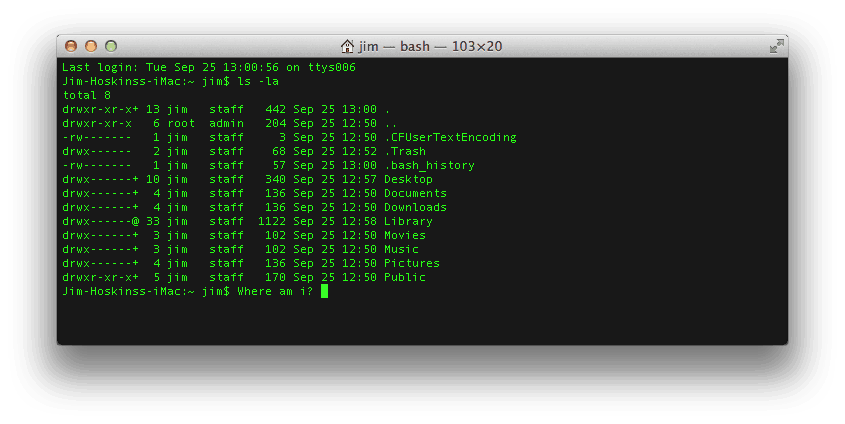
Mac Terminal Commands Cheat Sheet Pdf
killall Dock
If you want to take this process even further, you can dim apps that aren’t visible on your monitor(s):
defaults write com.apple.Dock showhidden -bool TRUE
killall Dock

Another easier option for those with the cluttered Dock is to check out uBar, a simple and minimal replacement. Instead of a long line of icons, you can now have a highly customizable bar that allows you to devote more space to the apps that matter most.
You can use uBar to preview, group, quit, or close apps and windows, without the need to open them first, across multiple monitors. It’s an altogether less distracting option for those who find the default Dock a bit cluttered or unpredictable.
Best Terminal for Mac alternatives
If you simply can’t get to grips with how to open Terminal on Mac or get comfortable with all of its ins and outs, you may want to investigate an app like MacPilot.
Get a perfect Terminal alternative
Install MacPilot, an appealing tool that will replace Terminal on your Mac. Over 1000 hidden macOS features and ease of use.
MacPilot grants access to more than 1,000 hidden features in macOS using UNIX without requiring that you learn any complicated commands. Instead, it offers users a Finder-esque window that groups tweaks by both application and function.
In most cases, enabling or disabling features with MacPilot is as simple as checking or unchecking the relevant boxes. You can also explore content across your disks using a File Browser that includes hidden files and detailed information about all available items.
The range of System Tools, reference guides, and secret tricks offered by MacPilot is a powerful alternative to Terminal for those who would rather avoid struggling with commands.
Why the Terminal window still matters
Try to wax lyrical about the benefits of Mac commands with fellow Apple users and there’s a good chance you’ll be met with them asking “what is a Terminal?” The fact is, this app isn’t something that the average Mac user ever bothers much with.
As you can see from the list of useful commands above, neglecting to use Terminal on Mac or an app like MacPilot means never seeing everything that your laptop or desktop is capable of.
Basic Mac Terminal Commands
One of many great things about using Mac Terminal commands is that, should you make a mistake, you can usually undo whatever you’ve done just by changing TRUE to FALSE and running the command again or simply changing the location or setting back to what it was before.
It’s true that Mac Terminal has a steep learning curve if you’re not used to its “language” but, whether or not you take the easier route with MacPilot, you can still try some of the cool tricks Terminal allows. You can play games, for example, by doing the following:
Open a Terminal window and type emacs then press Enter
With GNU Emacs selected, hit Escape
On the next screen, type x then tetris, pong or snake and press Enter
The most interesting example of a hidden Mac Terminal trick? That has to be the option to watch an ASCII version of the entire movie Star Wars:
telnet towel.blinkenlights.nl
Best Terminal Commands Mac
Grab some popcorn and enjoy!
Best of all, the apps mentioned throughout this article: CleanShot, Lungo, uBar, MacPilot — are all available for a free 7-day trial with Setapp, a platform for more than 150 apps to extend the possibilities of your Mac. See the best your Mac can do.
Meantime, prepare for all the awesome things you can do with Setapp.
Read onSign Up